


 The Prague Chamber Ballet and its long legacy of innovation and independence turn 45-years-young.
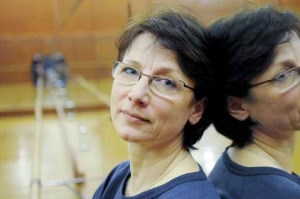
Kateřina Franková-Dedková says the Chamber Ballet allowed her to reach her full potential.
Back in 1964, when Luboš Ogoun, Pavel Šmok and Vladimír Vašut founded Balet Praha, they began with the aim of creating an original Czech ballet style by accentuating Czech music and folklore references.
With the Warsaw Pact invasion of 1968, however, that became a nearly impossible task.
Now, after many ups and downs, the Prague Chamber Ballet (as the group is now called) celebrates its 45th anniversary with a gala performance at the Dlouhá Theater March 1. What should be a simple celebration will have a somber air after founder Ogoun’s death this February at age 85.
Balet Praha’s pre-invasion years broke the traditional mold with adaptations of Leoš Janáček’s Intimate Letters and Béla Bartók’s The Miraculous Mandarin, among others.
„It was magic at the time that such ballets were created,“ says Kateřina Franková-Dedková, a soloist for much of the 1970s and ’80s, and now a choreographer. „We had troubles, but great people came together and made a creative atmosphere.“
In 1968, Šmok fled to Switzerland, and Ogoun took a job heading a Brno ballet company to avoid the Prague spotlight. By 1973, assuming the worst was over, Šmok and Balet Praha were back, this time under a new name: The Prague Chamber Ballet (Pražský komorní balet).
Conditions were difficult, to say the least. Arts were fully controlled by the regime, which only supported classical ballet and folk dance for their relative ideological safety. Modern expressionist pre-war dance was totally banned, and there was simply no modern dance in communist Czechoslovakia. A long tradition attaching ballet companies to an opera house made the Chamber Ballet even more iconoclastic.
As the regime collapsed, the founders looked for younger generations to carry the torch.
Antonín Schneider, the director of the Taneční centrum Praha and a one-time programmer for the National Theater Ballet, says there were attempts to include some of the Prague Chamber Ballet works into the National Theater Ballet repertoire.
„Even after the revolution, there was still such animosity from the Culture Ministry that it never happened,“ he says.
Now, the company is led by the young, enthusiastic choreographer Lucie Holánková. After a brief affiliation with the State Opera, the Prague Chamber Ballet began losing its creative edge. Holánková was studying under Šmok, and he granted her trademark rights to the Prague Chamber Ballet.
„It meant we had to start completely from scratch again,“ she says.
The March 1 gala program – dedicated to Ogoun – will be a mixed bill consisting of two older pieces by Pavel Šmok reconstructed by Franková-Dedková: Stabat by Antonín Dvořák and Transfigured Night (Zjasněná noc) by Arnold Schönberg, based on a poem about a woman telling her lover that she is bearing a stranger’s child. The evening ends with a contemporary piece Divocí koně (Wild Horses) with music by folk singer Jaromír Nohavica, choreographed by Holánková.
When Franková-Dedková is asked what she took from her years affiliated with the company, she quickly replies that, from an artistic point of view, she was allowed to fully develop her talent.
She is not alone, as a whole generation of dancers call the Prague Chamber Ballet a crucial influence in their artistic lives.
Antonín Schneider recalls the impressions of seeing a production as a 14-year-old and leaving the theater feeling he must leave everything else in his life to join Balet Praha.
While the original pieces of Balet Praha and the Prague Chamber Ballet have a museum quality about them compared with contemporary developments in modern dance, the works remain a milestone in Czech culture.
While Czechs seem hungry to import long-missing foreign influences and seek to modernize the arts, the death of Luboš Ogoun reminds us that the time to take notice of a piece of homegrown culture is now.
Foto: Vladimir Weiss
« Zpět do sekce Napsali o nás
Sdílet článek na: Twitter • Facebook